
Define Policy
Administrators configure products, entitlements, seat limits, and offline permissions in the central Authority, establishing the rules that govern how licenses can be used.

A clear, end-to-end licensing lifecycle — from defining policies and issuing trust to fast runtime enforcement, usage control, and operational support.
 How the Licensing Lifecycle Works
The control plane defines intent and rules centrally, while the runtime plane enforces them in real time with minimal latency.
This structured lifecycle follows the proven deployment model used across onboarding, floating seats, gateway operations, and security workflows.
Administrators configure products, entitlements, seat limits, and offline permissions in the central Authority, establishing the rules that govern how licenses can be used.
The system generates licenses and publishes signed trust material so applications can verify authenticity securely and independently.
Applications activate automatically when connected, or use a secure request-and-response flow for air-gapped and offline environments.
Floating seats are managed through lease and heartbeat mechanisms that track active usage and automatically reclaim seats when sessions expire.
Server-authorized usage tickets and idempotent ledger events ensure accurate metering and prevent over-consumption of licensed credits.
Built-in portal workflows, analytics, and correlation tracking provide full visibility, enabling fast troubleshooting and reliable audit trails.
Control Plane & Runtime Enforcement
The Authority (control plane) defines what is allowed.
The LicenseServer (runtime plane) ensures those rules are enforced in real time.
This separation keeps administrative workflows centralized while allowing runtime checks to remain fast, scalable, and reliable.
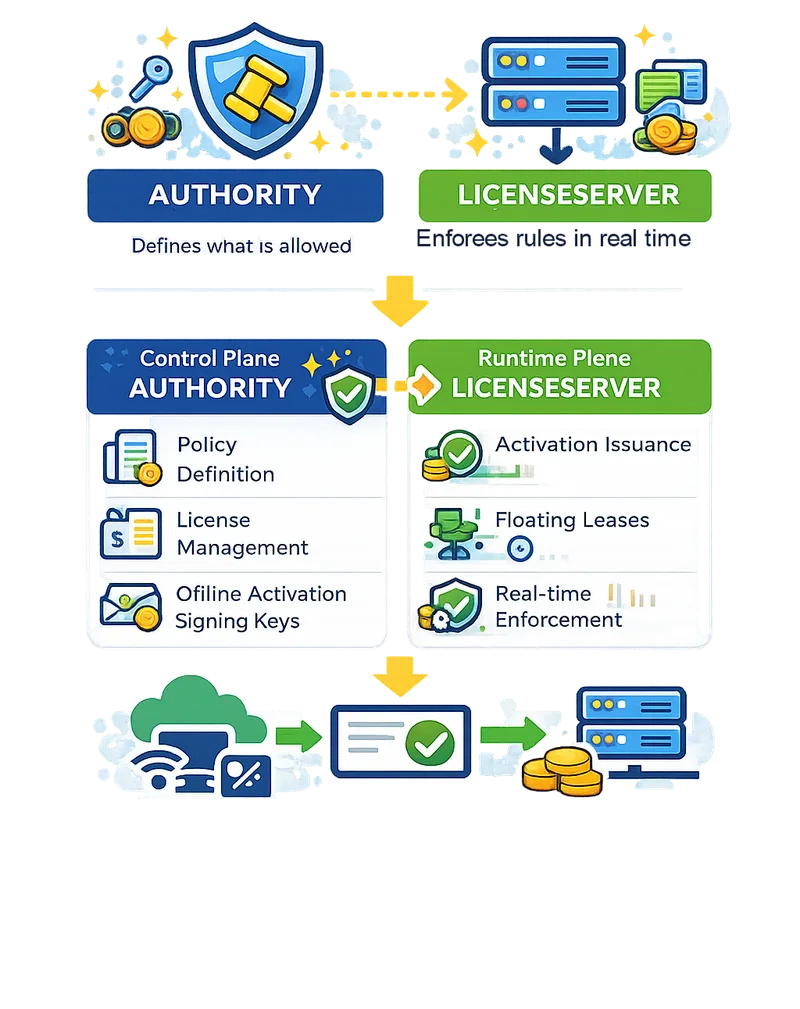
Control Plane (Authority)
Runtime Plane (LicenseServer)
Runtime Request Paths
Each interaction — whether activation, seat usage, or usage consumption — follows a clearly defined path with built-in validation, correlation, and idempotency controls.
This ensures that all operations are predictable, auditable, and resilient to failures or retries.
The application (via SDK) sends activation data to the server.
The server validates license status, policy rules, and device identity, then issues a signed activation token that the application can verify and use locally.
A seat is allocated through a lease during checkout.
The application maintains the lease using periodic heartbeats, and if the session ends or becomes inactive, the lease expires and the seat is automatically released.
Usage requests are validated against available quota and policy constraints.
Each request is handled idempotently to prevent duplication, then recorded in a usage ledger for accurate tracking, reporting, and reconciliation.
Start with a trial tenant, run online and offline scenarios, then tune policies for production.
© 2026 LicenseSeal. Powered by BytesGlue Inc. All rights reserved. Cookie Settings